
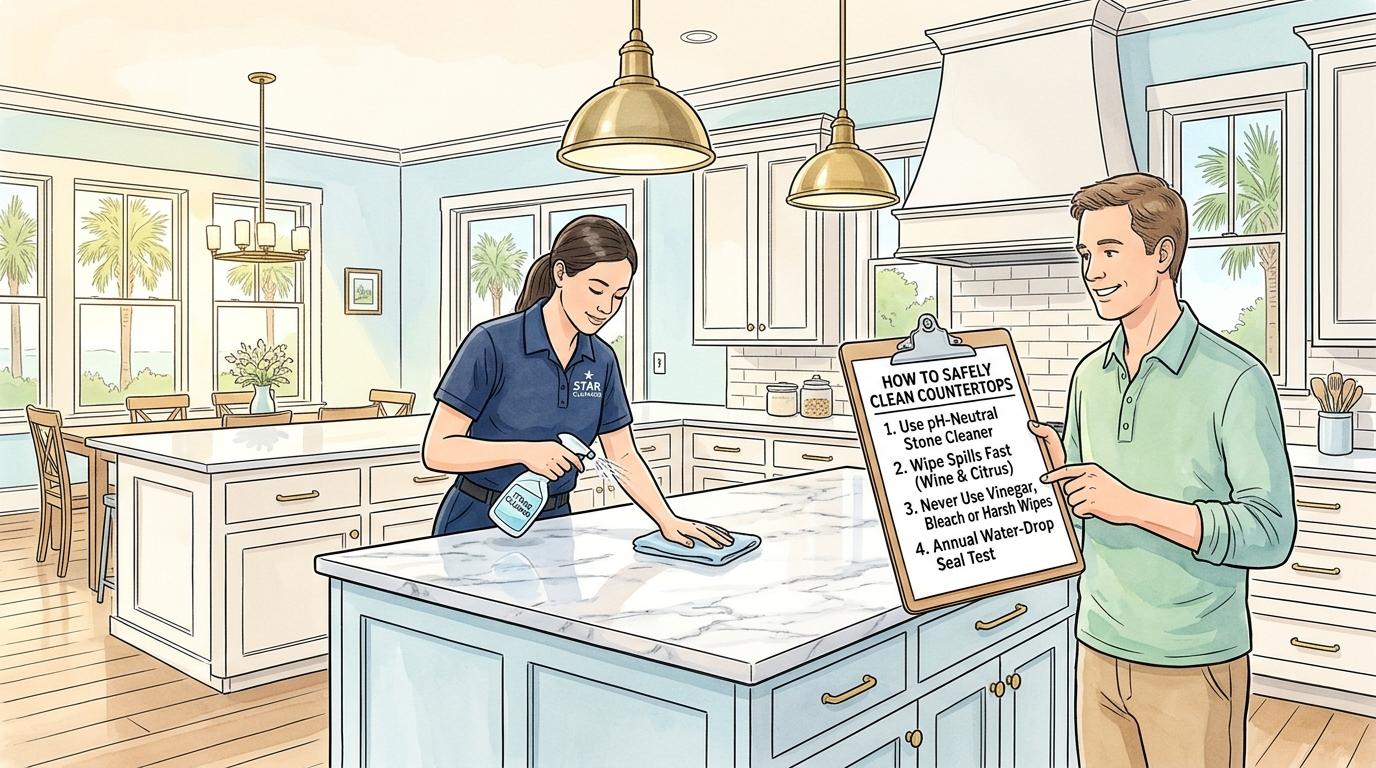
To clean granite, quartz, quartzite, and marble countertops safely in Charleston SC: 1) Use strictly pH-neutral cleaners (pH 7.0) or 3 drops of mild liquid dish soap mixed into warm water; 2) Never use vinegar, lemon, Windex, bleach, Clorox wipes, or Bar Keepers Friend, which chemically etch marble, strip granite sealers, and yellow quartz resin binders; 3) Wipe acidic holiday spills (wine, citrus, cranberry sauce, coffee) immediately; and 4) Buff dry with clean microfiber so Charleston’s hard tap water does not dry into crusty white mineral rings around your sink faucet.
Table of Contents (Jump to Section)
Why "All-Purpose" Sprays & Disinfecting Wipes Quietly Ruin Countertops
Walk into any kitchen renovation in Mount Pleasant (Old Village, I'On, Carolina Park), Downtown Charleston (French Quarter, South of Broad), or Daniel Island, and the centerpiece is almost always a massive natural stone or engineered quartz island.
Yet the number-one mistake homeowners—and untrained house cleaners—make is wiping these $8,000+ slabs with standard grocery-store multi-surface sprays, ammonia glass cleaners, or disinfecting wipes:
Carrara marble, travertine, and limestone are calcium carbonate. Even mild organic acids dissolve the microscopic polish, leaving flat, chalky "water rings" that look permanently dirty in raking sunlight.
Engineered quartz (popular in Summerville's Nexton and West Ashley's Grand Oaks) is held together by 7%–10% polymer resins. High-pH bleach and abrasive scouring powders burn or yellow that clear resin, voiding manufacturer warranties.
Marble vs. Quartzite vs. Granite vs. Quartz: Know Your Surface
Charleston homeowners frequently confuse Quartzite (a hard natural metamorphic stone) with Quartz (a man-made engineered slab). Each surface demands slightly different daily habits:
1. Carrara & Calacatta Marble (Downtown Historic Homes & Luxury Baths)
Soft, porous, and acid-sensitive. Wipe red wine, lime, coffee, and tomato sauce within minutes. Never allow toothpaste or harsh bathroom tile cleaners to sit on marble vanity tops—use only pH-neutral stone spray and seal every 6–12 months.
2. Natural Granite & Taj Mahal Quartzite (Mount Pleasant & James Island)
Extremely scratch- and heat-resistant, yet still naturally porous. Cooking oils near the stove will darken unsealed granite over time. Clean daily with mild dish soap or stone cleaner, and reseal once a year if water stops beading.
3. Engineered Quartz (Nexton, Cane Bay, West Ashley & Riverland Terrace)
Non-porous and never requires sealing—but cannot tolerate high alkaline degreasers, bleach, acetone nail-polish remover, or hot baking sheets directly out of the oven, which scorch the resin binder yellow.
The 4-Step Stone-Safe Daily & Weekly Cleaning Blueprint
Follow the exact color-coded microfiber protocol our technicians use inside charleston residences every day:
Dry-Sweep Loose Crumbs & Salt Grit First
Before spraying anything, sweep away kosher salt crystals, coffee grounds, and dried crumbs with a dry microfiber cloth. Grinding sharp salt grains under a wet sponge creates micro-scratches in softer stone finishes.
Apply pH-Neutral Stone Cleaner or Mild Dish Soap
Mist your countertop with a dedicated pH-neutral stone cleaner (or mix 3 drops of clear liquid dish soap in 16 oz of warm distilled water). Never use bathroom tub cleaners or scouring pads around kitchen sinks.
Lift Dried Food Gently with a Plastic Scraper
For dried gravy, candle wax, or baked sugar spots, lay a warm damp cloth over the spot for 3 minutes to soften it, then gently nudge it off using a soft plastic putty knife—never steel wool or green Scotch-Brite pads.
Buff Completely Dry to Stop Hard Water Crust
Follow immediately with a dry microfiber buffing towel, especially behind the kitchen faucet. Charleston’s mineral-rich water leaves cloudy white calcium halos if allowed to air-dry—similar to what builds up on glass shower doors (see our Hard Water Stain Removal Guide).
Emergency Holiday Stain Fix: Red Wine, Cranberry & Cooking Oil
Hosting Thanksgiving or holiday parties this season? If a guest accidentally leaves a deep red wine ring or olive oil splatter overnight on unsealed granite or marble, do not scrub it aggressively. Instead, pull the pigment back out using a gentle Baking Soda Poultice:
- For Oil/Grease Stains: Mix baking soda + acetone (or rubbing alcohol) into a thick peanut-butter paste. (Skip acetone on engineered quartz!).
- For Wine/Coffee/Berry Stains: Mix baking soda + 3% hydrogen peroxide (safe on light stone; test dark granite first) into a thick paste.
- Spread a 1/4-inch layer over the stain, cover tightly with plastic wrap, tape the edges down, and let it sit 24 hours. As the paste dries, capillary action draws the trapped stain out of the stone pores.
The 15-Second Water-Drop Seal Test
Not sure whether your granite or marble needs resealing before family visits? Try this quick homeowner diagnostic right next to your kitchen sink:
Pour a quarter-sized puddle of tap water on the stone near the prep zone and wait 10 minutes. If the droplet stays tightly beaded on top and the stone underneath stays its original light color, your penetrating sealer is intact.
If the water flattens out and leaves a dark wet shadow within 3–5 minutes, the stone pores are wide open. Wipe it dry and apply a fluoropolymer penetrating stone sealer (takes 20 minutes and lasts 1–2 years).
Questions Charleston Homeowners Ask About Stone Countertops
How do I sanitize marble or quartz after cutting raw chicken without bleach?
First, always cut raw poultry on a dedicated plastic or wood cutting board, never directly on stone. To sanitize the surrounding counter safely, wash first with warm soapy water, rinse, and wipe with a stone-safe hydrogen-peroxide or 70% isopropyl alcohol disinfectant labeled safe for sealed natural stone and quartz, then dry immediately.
Can my regular house cleaner ruin my countertops if they bring their own sprays?
Yes—this happens surprisingly often when hiring unvetted gig cleaners who carry generic acidic bathroom sprays or cheap bleach into your kitchen. At Star Cleaning SC, our W-2 trained technicians follow a strict color-coded microfiber protocol and carry stone-safe pH-neutral products specifically formulated for Lowcountry marble, granite, and quartz.
Is your Thanksgiving deep clean safe for historic marble and heart-pine homes?
100%. Whether you own an antebellum home Downtown or a modern kitchen in Mount Pleasant, we match our chemistry to your exact finishes—never using steam mops on heart-pine or acids on marble. Check out our 20% OFF Thanksgiving Special (Code: THANKS) before holiday slots fill up!
Explore More Lowcountry Home Care Guides
Trust Your Stonework & Kitchen to Charleston's Surface-Safe Pros.
From Carrara marble in Historic Charleston to quartz islands in Mount Pleasant and Summerville, we bring pH-neutral, pet-safe chemistry and $2M insured peace of mind.