
How to Remove Hard Water Stains & Mildew from Shower Glass and Grout
Tired of looking through milky, cloudy shower doors and staring at dark grout lines? Here is the exact chemistry and cleaning protocol professional maids use to conquer Lowcountry mineral scale.
Star Cleaning SC Editorial Team
Bathroom Sanitation & Descaling Specialists • Charleston & Summerville, SC
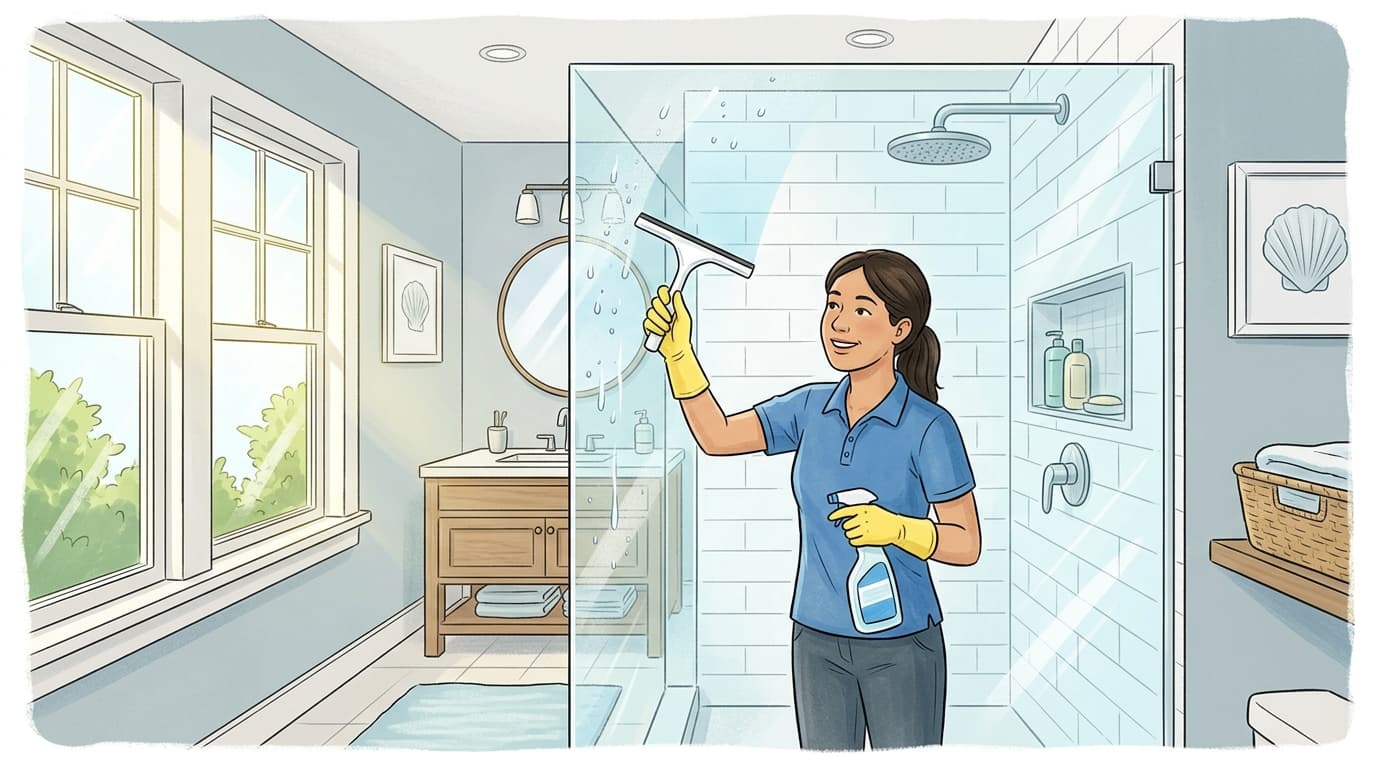
You walk into your bathroom, turn on the lights, and admire your custom tile shower—until you look closely at the frameless glass doors. Instead of sparkling clarity, you see a cloudy, chalky white haze. And down in the tile seams, stubborn black mildew and orange scum stubbornly cling to the grout lines.
You spray standard store-bought glass cleaner, scrub until your shoulders ache, and rinse. But the second the water dries, the white haze reappears exactly as before. Why does this happen?
In coastal South Carolina—from Charleston and Mount Pleasant to Summerville—our municipal and well water supplies carry heavy concentrations of dissolved calcium carbonate, magnesium, and silica minerals. Every time you shower, water droplets sit on vertical surfaces. As humidity and heat cause the water to evaporate, mineral crystals are left behind. Over weeks, these minerals bond directly with the microscopic pores of silica glass, creating hard water “scale” (limescale) that standard alkaline cleaners cannot dissolve.
In this wikiHow-style guide, our technicians at Star Cleaning SC share the professional chemistry, tools, and step-by-step method used during our residential deep cleaning services to restore cloudy shower glass to diamond clarity and eradicate tile grout mold once and for all.
At a Glance: The Pro Descaling Protocol
Core Principle: Acid dissolves alkaline minerals; dwell time beats elbow grease; hydrophobic sealant prevents recurrence.
1The Chemical Caddy: Understanding What Cuts Limescale
Cleaning hard water is a matter of pH balance. Minerals like calcium and magnesium are alkaline (pH 8.5–9.5). To break their chemical bonds, you must use an acidic descaler (pH 2.0–3.5). Conversely, soap scum contains animal fats and oils, which require surfactants and gentle abrasives.
Solutions & Chemical Agents
- Sulfamic or Citric Acid Descaler: Much more effective than household vinegar; clings to vertical glass without evaporating quickly.
- Baking Soda & Dawn Dish Soap: The ultimate degreaser and mild physical buffer to strip greasy body oils and conditioner films.
- 3% Hydrogen Peroxide: Bleaches mold stains in porous grout without eroding cement or producing hazardous chlorine gas.
- Hydrophobic Polymer Sealant: Rain-repellent coating (Rain-X Shower Door or ceramic spray) to create an invisible water barrier.
Tools & Non-Scratch Hardware
- White Non-Scratch Scrubbing Pads (Scotch-Brite 7445): Specially rated for glass. Never use green or maroon pads, which contain aluminum oxide that scratches tempered glass!
- V-Shaped Grout Detailing Brush: Dense, angled nylon bristles reach down into grout recess channels without splaying.
- 12-Inch Silicone Channel Squeegee: A sharp, pliable rubber blade wipes glass completely dry in a single stroke.
- Waffle-Weave Microfiber Glass Towels: High-density microfibers leave zero lint and buff away water droplets without streaks.
2The 7-Step Step-by-Step Shower Restoration Protocol
Follow these steps in exact chronological sequence. Rushing the chemical dwell time is the #1 reason homeowners fail to get clear results.
Step 1: Steam Pre-Rinse & Thermal Softening
Before applying chemicals, turn the shower on hot for 3 to 5 minutes with the bathroom door closed. The warm steam expands glass microscopic pores and softens the greasy outer layer of body oils, body wash, and shampoo conditioners that coat the calcium crystals.
Step 2: Apply the Descaling Solution & Honor the 15-Minute Dwell Time
Spraying and immediately scrubbing is useless against calcified scale. Chemistry does the heavy lifting, not muscle.
• The Acid Soak: Spray your concentrated citric or sulfamic descaling spray generously across the glass. For severe buildup, mix 1 cup of baking soda with 3 tablespoons of Dawn dish soap and 2 tablespoons of citric acid powder into a thick foaming paste.
• Wait 15 Minutes: Let the acid sit undisturbed. You will see faint bubbling as the acidic hydrogen ions react with the alkaline calcium carbonate, converting hard minerals into water-soluble calcium salts.
Step 3: Agitate Mineral Scale with White Non-Scratch Pads
Once the mineral scale is chemically loosened, use a Scotch-Brite 7445 white nylon pad (or #0000 ultra-fine bronze/brass wool).
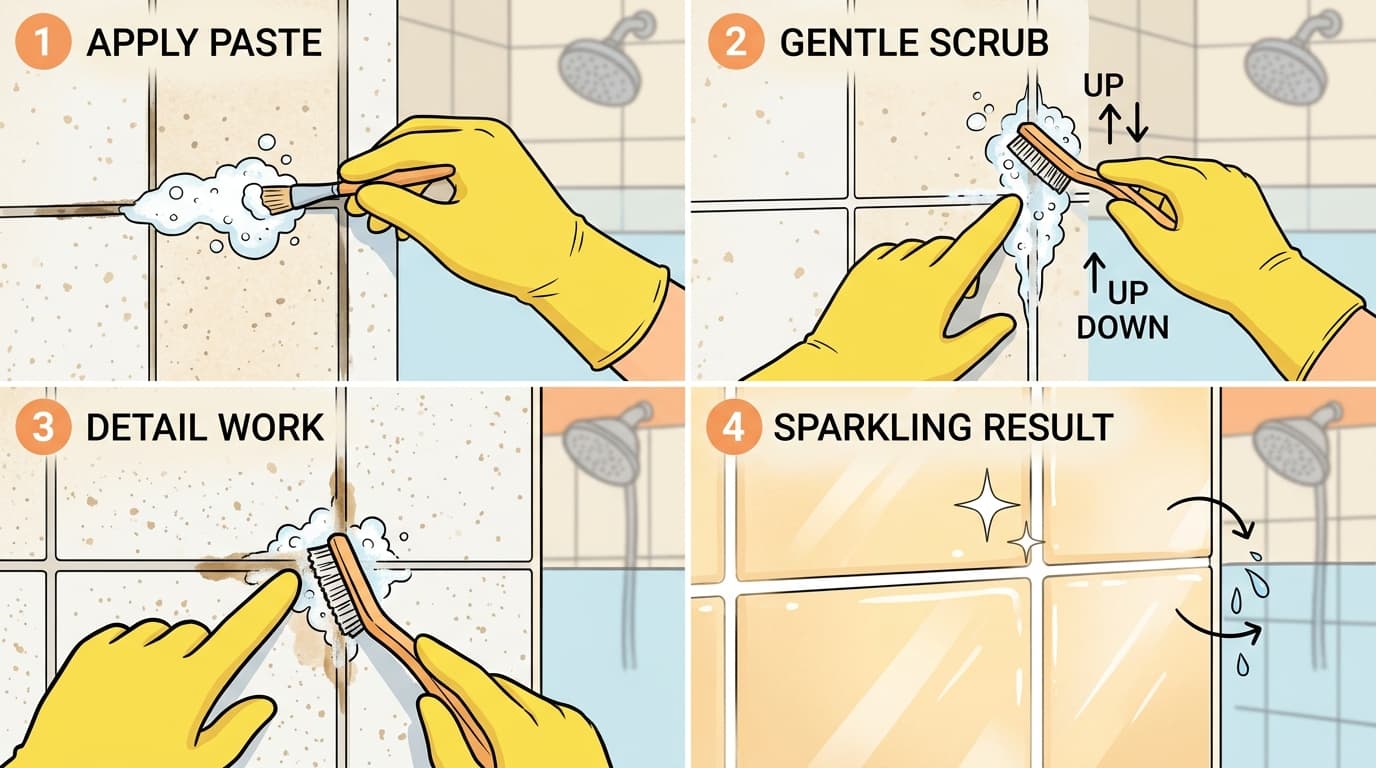
Step 4: Eradicate Grout Mildew with Oxygenated Peroxide Paste
Do not reach for standard chlorine bleach! Chlorine bleach only bleaches the surface pigment of mold while adding water that feeds mold hyphae deep inside porous grout.
- The Oxygen Bleach Paste: Mix baking soda with 3% hydrogen peroxide into a spreadable frosting consistency.
- Paint Grout Lines: Apply the paste directly into discolored grout seams. Let it bubble for 20 minutes; oxygen micro-bubbles physically lift mold spores out of microscopic cement pores.
- Scrub with V-Grout Brush: Scrub along the grout seams with the angled brush. The mold and discoloration will wash away effortlessly.
Step 5: Detail Caulk Corners, Drain Flanges & Hinge Hardware
Pink slimy residue in corners is not actually mold; it is Serratia marcescens, an airborne bacterium that feeds on fatty deposits in soap and shampoo.
Step 6: Cold Water Power Rinse & Squeegee Dry
Rinse all descaling acid and baking soda residue thoroughly using cold water. Cold water causes remaining surface minerals to tighten and wash away cleanly rather than redepositing.
- The Squeegee Technique: Hold the squeegee at a 45-degree angle. Pull straight down from the very top of the glass to the bottom in smooth, continuous strokes. Wipe the rubber blade with a dry microfiber cloth between each pass.
- Edge Detailing: Use a dry waffle-weave microfiber cloth to dry the perimeter edges, bottom silicone sweep, and floor threshold.
Step 7: Apply Hydrophobic Polymer Glass Sealant & Grout Shield
If you stop after step 6, hard water spots will reappear within 7 days. You must seal the microscopic pores of both the glass and the grout!
Printable Shower Maintenance Schedule for Lowcountry Homes
Keep your shower looking like a 5-star hotel year-round with this simple maintenance rhythm:
⏱️ Daily (30 Seconds)
- • Squeegee glass after last shower
- • Quick wipe of bottom glass track
- • Run bathroom exhaust fan for 20 min
- • Leave shower door cracked open for airflow
🧼 Weekly (10 Minutes)
- • Mist glass with light maintenance spray
- • Wipe down chrome handles & hinges
- • Spray pink bacteria from corners
- • Clear hair from drain strainer
🛡️ Semi-Annual (1 Hour)
- • Deep acid descaling soak
- • Oxygen bleach peroxide grout scrub
- • Re-apply Rain-X hydrophobic coating
- • Check & re-seal tile grout joints
4 Dangerous Shower Cleaning Mistakes That Ruin Finishes
Mistake 1: Using green Scotch-Brite scouring pads on glass
Green kitchen pads contain aluminum oxide, which is harder than glass. Scrubbing with them will leave permanent swirl marks and scratches across your tempered glass shower door.
Mistake 2: Pouring harsh chlorine bleach on unsealed grout
Bleach is corrosive to cement binders. Over time, repeated bleach applications erode grout lines, causing powdery disintegration and loose tiles.
Mistake 3: Letting acidic descalers drip onto marble or limestone floors
Calcite-based natural stone reacts violently with acids (even vinegar and lemon juice), causing dull white chemical burns called etching that require diamond polishing to repair.
Mistake 4: Skipping the squeegee in coastal humidity
Allowing mineral-heavy water droplets to air-dry every single day guarantees permanent mineral etching within 6 months. A 30-second squeegee routine stops 95% of scale before it starts.
Tackling a whole-home refresh? Check out our complete wikiHow guide on How to Deep Clean Your House Step-by-Step. Moving into a newly purchased home? Read our Move-In Deep Cleaning Checklist. Or learn how to clean fine dust after remodeling in our Post-Construction Cleaning Guide.
Frequently Asked Questions
Why does vinegar fail to remove cloudy hard water spots on shower glass?
Household white vinegar has only 5% acetic acid. In coastal South Carolina, groundwater is rich in hard calcium carbonate and magnesium silicates that bond chemically with silica in glass. Vinegar evaporates too quickly before it can dissolve thick mineral deposits. Professional maids use concentrated citric or sulfamic acid formulas combined with baking soda paste and 15 minutes of chemical dwell time.
Can razor blades scratch tempered glass shower doors?
Yes! While stainless steel blades are sometimes used by window cleaners, shower doors often have microscopic manufacturing imperfections, microscopic grit, or protective coatings. Scraping at the wrong angle or with dry glass will permanently scratch tempered glass. Professionals use white non-scratch nylon pads (like Scotch-Brite 7445) or ultra-fine #0000 brass wool, which are softer than glass but harder than mineral scale.
Why does pink residue and black mold keep coming back to shower grout in Charleston?
The pink film is actually Serratia marcescens (an airborne bacterium that feeds on fatty soap residue), while black mold grows because cementitious grout is highly porous like a sponge. In Charleston's 70% to 90% ambient humidity, grout stays damp for hours. If grout is not sealed with a penetrating silicone sealer, mold roots embed deep beneath the surface.
How much does professional bathroom deep cleaning cost in Charleston & Summerville, SC?
A comprehensive primary bathroom restoration—including glass descaling, grout scrub, tile sanitization, and chrome polishing—typically costs between $120 and $220 as a standalone service, or is included in a whole-home residential deep clean starting at $280 to $480.
Let Our Pros Restore Your Bathrooms to Sparkle
Star Cleaning SC removes years of hard water scale, soap scum, and tile mold in a single visit. Trained, insured, and veteran-owned service in Charleston, Summerville, and Mount Pleasant.