
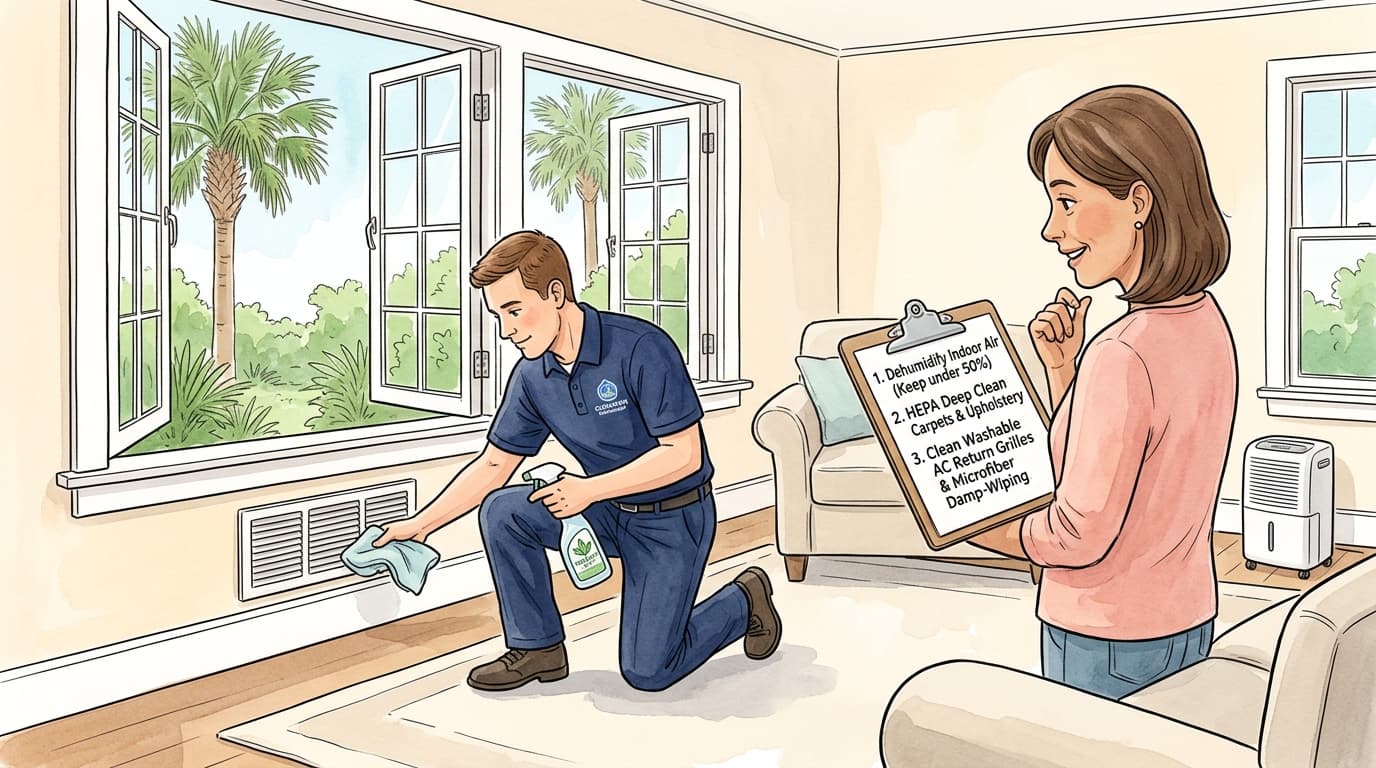
To get rid of a musty smell in a Charleston SC home, you must treat the moisture source and the organic fuel simultaneously: 1) Lower indoor relative humidity under 50% and switch the HVAC thermostat fan from 'ON' to 'AUTO' so moisture on cooling coils does not re-evaporate; 2) Wash return air grilles with botanical antimicrobials to eliminate mildew spores; 3) Extract embedded organic dust and skin flakes from baseboards, carpets, and window trim with sealed commercial HEPA filtration vacuums; and 4) Never mask the odor with aerosol perfumes, which combine with damp air into a heavy, cloying scent.
Table of Contents (Jump to Section)
Why Charleston Homes Develop That "Old Coast" Musty Smell
Whether you live in a historic single house in South of Broad, a tidal creek home in James Island or Mount Pleasant (Old Village), or a newer build in Summerville (Nexton & Cane Bay), that distinct "musty attic" or "wet towel" scent is actually a chemical compound called mVOCs (microbial Volatile Organic Compounds).
In coastal South Carolina, summertime relative humidity hovers between 75% and 95%. Whenever indoor relative humidity climbs above 55% to 60%, dormant mold spores and dust mites activate. As these microscopic organisms digest organic skin flakes, cellulose, and cooking oils trapped in fine dust, they emit volatile waste gases into your living room air.
That is why spraying plug-in fresheners, Febreze, or lighting scented candles fails: perfumes simply sit on top of the volatile gases, creating a nauseating "vanilla-mildew" cocktail. To fix the smell, you must eliminate the moisture and strip away the organic dust feeding it.
The #1 Thermostat Mistake in South Carolina (The "Fan ON" Trap)
Over 60% of Charleston homeowners suffering from persistent musty odors have one simple setting wrong on their smart thermostat (Nest, Ecobee, or Honeywell):
When your AC cools, condensed water pools on the indoor coil and drip pan. If your fan is set to ON, the blower keeps running after the cooling cycle stops, blowing warm humid air across that wet coil and forcing gallons of evaporated moisture back into your rooms.
When set to AUTO, the blower turns off when cooling stops, allowing condensation to drain outside safely via the condensate PVC line. This single adjustment can drop indoor humidity by 8% to 12% within 48 hours.
Step-by-Step 4-Phase Blueprint to Eliminate Odors for Good
Follow this sequential protocol developed by our operations team to eradicate musty smells at the microscopic root:
Dehumidify to 45%–50% Relative Humidity
Microbial growth halts when relative humidity stays below 50%. In damp months (May through October), install a dedicated whole-home dehumidifier or run portable 50-pint units in finished rooms over crawl spaces or bonus rooms above garages (FROGs).
Wash Return Air Grilles & Swap to MERV 11 Filters
Metal return grilles suck in pet hair, cooking grease, and dust, creating a dark, damp incubation layer. Unscrew return grilles, wash them in warm water with botanical castile soap or dish detergent, and replace HVAC filters every 60 days.
Deep HEPA Vacuuming of Baseboards & Soft Surfaces
Standard bagless vacuums blow spore-laden dust back into the air. Star Cleaning SC utilizes commercial sealed-body HEPA vacuums that capture 99.97% of particles down to 0.3 microns, removing the organic food layer from baseboard crevices, window sills, and area rugs.
Damp-Mop Hardwoods with pH-Neutral Wood Cleaners
Never soak historic heart-pine or modern engineered hardwoods with dripping string mops—water seeping into tongue-and-groove seams breeds subfloor mildew. Use flat microfiber pads dampened with neutral wood-safe cleansers that dry in under 90 seconds.
Crawl Spaces & The Lowcountry "Stack Effect"
In Charleston, homes are traditionally elevated on brick piers or crawl spaces to protect against tidal storm surges. However, this creates a thermal phenomenon known as the Stack Effect:
How Crawl Space Odor Enters Your Master Bedroom
As warm air rises and exits through upper attic soffits, negative pressure sucks air upward from your crawl space. Up to 50% of the air you breathe on your first floor originated in your crawl space!
If your crawl space has exposed dirt or standing moisture, musty earth odors seep through pipe penetrations, subfloor seams, and floor vents. Regular professional deep cleaning seals the indoor surfaces, while crawl space encapsulation stops the moisture source beneath.
Questions Charleston Homeowners Ask About Musty Smells
Will a deep clean completely remove the musty odor?
Yes, when paired with proper indoor humidity management. A professional initial deep clean physically strips away the embedded dust layers, sanitized AC returns, and cleans high-condensation zones. Keeping indoor humidity under 50% guarantees the smell does not return.
Should I open windows on pleasant spring or fall days in Charleston?
Only if the outdoor humidity is below 55%. Often in October or April, the temperature feels nice at 72°F, but outdoor humidity is 80%+. Opening windows lets hundreds of cubic feet of moisture soak directly into your furniture fabrics, rugs, and drywall.
Do you clean air duct interiors?
We thoroughly sanitize exterior registers, vent grilles, and air return louvers where heavy surface dust collects. For deep mechanical duct trunk line cleaning inside the attic, we partner with certified Lowcountry NADCA specialists.
Explore More Charleston Homeowner Guides
Breathe Crisp, Truly Clean Air in Your Home.
Reset your indoor air quality with military-grade deep cleaning in Mount Pleasant, Charleston, Summerville, and Daniel Island. Sealed HEPA filtration, non-toxic products, and guaranteed freshness.